 Publisher: IDW Publishing
Written By: ‘Pegleg’ Peter Bagge, ‘Vomitin’ Vito Delsante, ‘Barnacle’ Bill Wray, ‘Junky’ Jeff Zapata, ‘Torn’ Shaun Manning, ‘Smoky’ Joe Simko.
Art By: ‘Pegleg’ Peter Bagge, ‘Green’ Dean Haspiel, Hilary ‘Barfin’ Barta, ‘Junky’ Jeff Zapata, ‘Skid’ Mark Pingitore, ‘Smoky’ Joe Simko, Jay ‘Decay’ Lynch, ‘Dead’ Fred Wheaton.
Colours By: ‘Pegleg’ Peter Bagge, ‘Junky’ Jeff Zapata, Jason ‘Basin’ Millet, , ‘Skid’ Mark Pingitore, ‘Green’ Dean Haspiel, ‘Smoky’ Joe Simko.
Letters By: ‘Slobby’ Robbie Robbins
Edited By: Denny ‘saur’ Tipton.
Covers By: ‘Skid’ Mark Pingitore, ‘Pegleg’ Peter Bagge, ‘Smoky’ Joe Simko.
Release Date: December 24th, 2014.
‘The Garbage Pail Kids’ Baseball Card Series by the Topps Company erupted onto the pop culture landscape in 1985 as a pukey parody of ‘Cabbage Patch Kids'(which I personally find way more disturbing than the deliberately grotesque GPK’s)and ended up the more culturally significant. Conceived by legendary cartoonist Art Spiegelman(Maus, Raw)and initially brought to life by John Pund, they were the perfect product for young kids, like me, who were growing out of the gross out antics of Roald Dahl’s books, Fungus The Bogeyman and ‘Oink!’ comic, but had yet to discover ‘Viz’, ‘The Fabulous Furry Freak Brothers’ and Robert Crumb.
Everyone I knew who was worth the time to talk to in primary school had a stack of the cards to swap with, just as everyone who declared them as puerile basically proved themselves too boring to engage with in doing so. My bedroom door, walls, cabin style bed, television, ZX Spectrum computer and ghetto blaster were all covered in GPK stickers and, before long, a war of attrition had developed between my mother and I. By day she’d rip them off and by tea time I’d have them replaced.
The cards featured art of an excellent quality(James Warhola, nephew of Andy Warhol, was one of the many artists to follow Pund), and the nutty names tended to be as inventive as the weird and wonderful caricatures on the cards, ”Evil Eddie’, ‘Ray Dekay’, Dead Ted’, ‘Drunk Ken’, et al, would succinctly capture what the character was all about. ‘Adam Bomb’, the one everyone probably will remember the most vividly, had a mushroom cloud coming out of the top of his blown apart skull, and is without doubt the best representation of what the GPK’s were all about: irreverent, unsettling and anarchic fun.
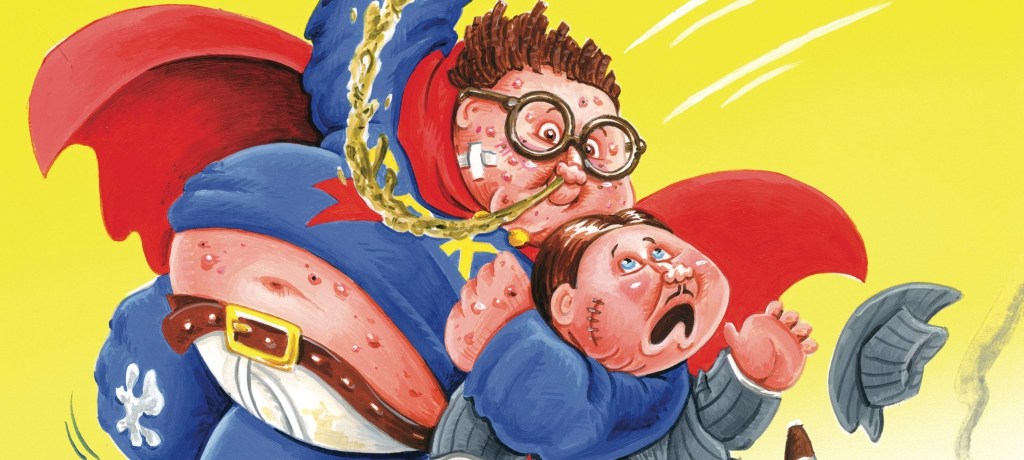
Surprisingly, ‘Garbage Pail Kids Puketacular #1′ is actually the first Garbage Pail Kids comic ever, despite the fact an animated TV series(which actually got a couple of episodes on the air befire being banned) and live action movie (albeit one with a 2.8 rating on imdb) were both produced within five years of the cards’ initial release. Fortunately, the current editors of IDW have been as astute as Spiegelman and brought in some serious talent for the Kid’s comic book debut. ‘Pegleg’ Peter Bagge(Hate, Sweatshop ) Hilary ‘Barfin’ ‘ Barta(Plastic Man, Tomorrow Stories ) and ‘Green’ Dean Haspiel(American Splendor, The Alcoholic) are just three of the names involved, and probably the best known of them all.
Peter Bagge is up first, with a tale following Nat Nerd and Comic Con Ron as they take a jaunt through a comic convention for and by Garbage Pail Kids. The story parodies comic culture as much as it honours the legacy of the GPK, and makes neat reference to the GPK’s predecessor at Topps ‘Garbage Candy'(which was also conceived by Art Spiegelman), as Nat scours the convention in search of some. I remember these, too, in fact, and as the name suggests, it was candy shaped like garbage (fish heads, discarded newspapers, bricks, etc.) that came in day-glo bin shaped containers and had a knack for baffling parents as much it delighted their kids.
The second story, by Bill Wray and Hillary Barta, enters the realm of the superhero, appearing to target the characters of DC in particular. Instantly recognisable analogues of Superman, Batman, Plastic Man, The Spectre, Aquaman and more lurk in the background as twin characters who feature in the exact same card(Potty Scotty and Jason Basinburster)argue over who was the actually featured on said card. An enjoyably daft story follows, poking as much fun at the GPK line’s tendency to use more than one name for each character as it does the superhero genre.
Shaun Manning and Mark Pingitore’s contribution sees a return to the comic con, and delightfully skewers a certain type of rigid fanboy mentality while its there. Live Mike(whose card featured him as a rock star being electrocuted, natch.) deals with his pedantic fans in a signing queue, a nifty plot device that allows for plenty of secondary characters to pass through the 3 page story.
Of them all, I was most looking forward to Dean Haspiel’s contribution(written by Vito Delsante), as I’m a huge fan of his work with Harvey Pekar and Jonathan Ames. That left me a little disappointed to find that it was only a single page story. This means that I can’t really say much about it other than it looks good, is fairly amusing and contains a nod to to EC Comics with the character and lettering style used within it.
Joe Simko’s tale features ‘Norm Pierson’, a character who was a representation of ‘real people’ in the cards and is therefore the perfect protagonist for any GPK tale. In an origin tale not a million miles from that of a certain Kryptonian, we learn how he became trapped in the GPK universe and his efforts to fit in with the inhabitants. As with the other stories, I had a lot of fun trying to remember the names of the characters featured, and was a bit surprised by how many I remember, after what has to be at least 20 years since the last time I bought a pack of GPK cards!
Finally, Jeff Zapata tells a story of how ‘Fryin’ Brian’ could have ended up being electrocuted(it’s amazing how many GPK’s were shown with electricity coursing through their bodies) as he steals a comic and slips on a dog turd. I really liked the art in this story, and will be seeking out more of Jeff Zapata’s stuff in the future.
None of the stories featured here are ever going to win a Pultizer like Art Spiegelman’s other famous creation, Maus, or even an Eisner, but I suppose that’s the point. Just as the cards were an excuse for cartoonists to let loose and thrill kids of a certain mindset with the disgusting depictions, this comic is the perfect vehicle for the creators to play with the legacy of those cards and give the rest of us a laugh in doing so. I suppose for anyone who isn’t familiar with the cards, the relentless toilet humour would probably be a bit much, but the truly excellent caricature work by all artists featured more than makes up for it.
Rating: 4/5.
[CLICK COVER FOR FULL SIZE IMAGE]


The writer of this piece was: Jimi Longmuir
You can follow Jimi on Twitter @jimijokk
 BIG COMIC PAGE
Leave a Reply