
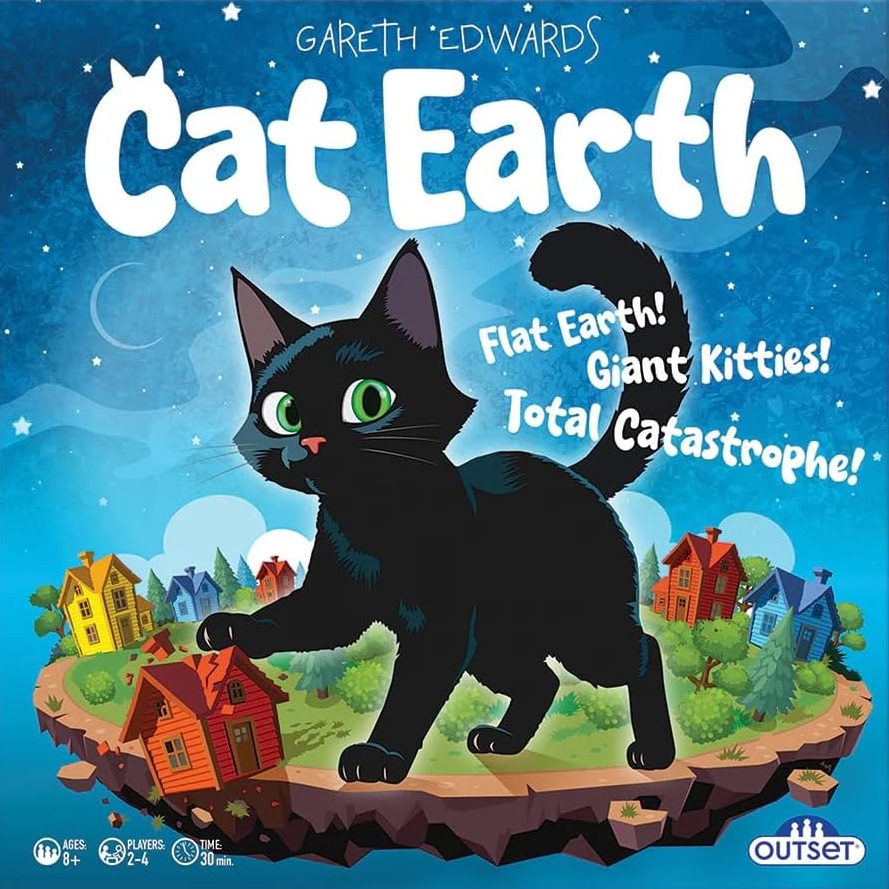
CAT EARTH
- 2-4 Players
- Recommended Age: 8+
- Time: 30 minutes
- RRP: £20 (though you can get it significantly cheaper from the fine folks at Zatu Games)
OVERVIEW
In Gareth Edwards’ Cat Earth, players play cards to scoot giant cats around the board, trying to nudge their opponents’ houses off the edge of the world. It’s chaotic, silly, and surprisingly tactical – and the last player with any houses left wins.
WHAT’S IN THE BOX?
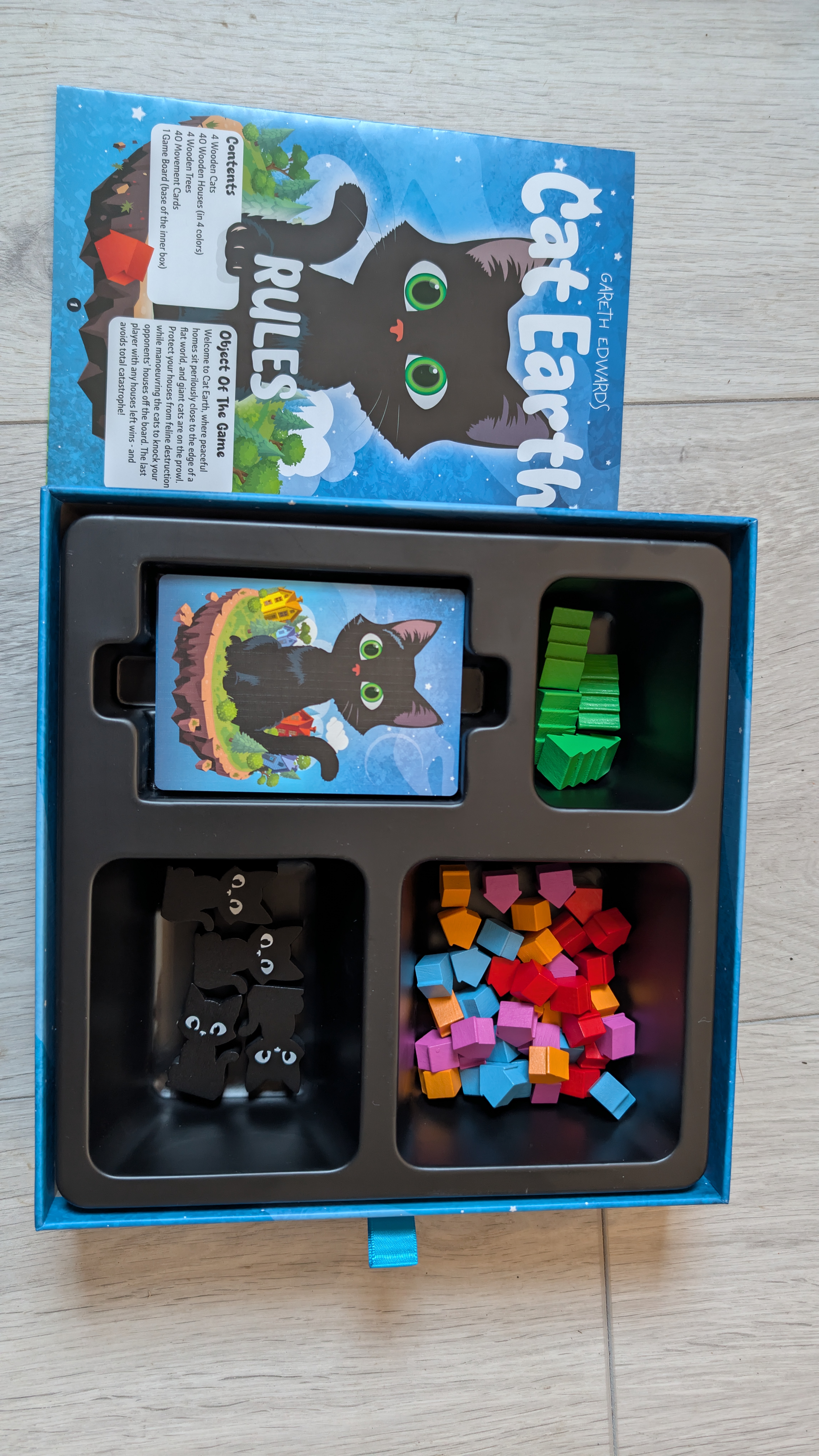
The box contains the following:
- 1 Game Board
- 4 Wooden Cats
- 40 Wooden Houses (in 4 colours)
- 4 Wooden Trees
- 40 Movement Cards
- Rulebook
The components here are simple but effective, with clean wooden tokens very much the order of the day. The cats, trees, and houses are all nicely eye‑catching, and I particularly like how the movement cards match the scale and layout of the board’s squares – it makes plotting your cat’s path feel wonderfully intuitive.
HOW TO PLAY
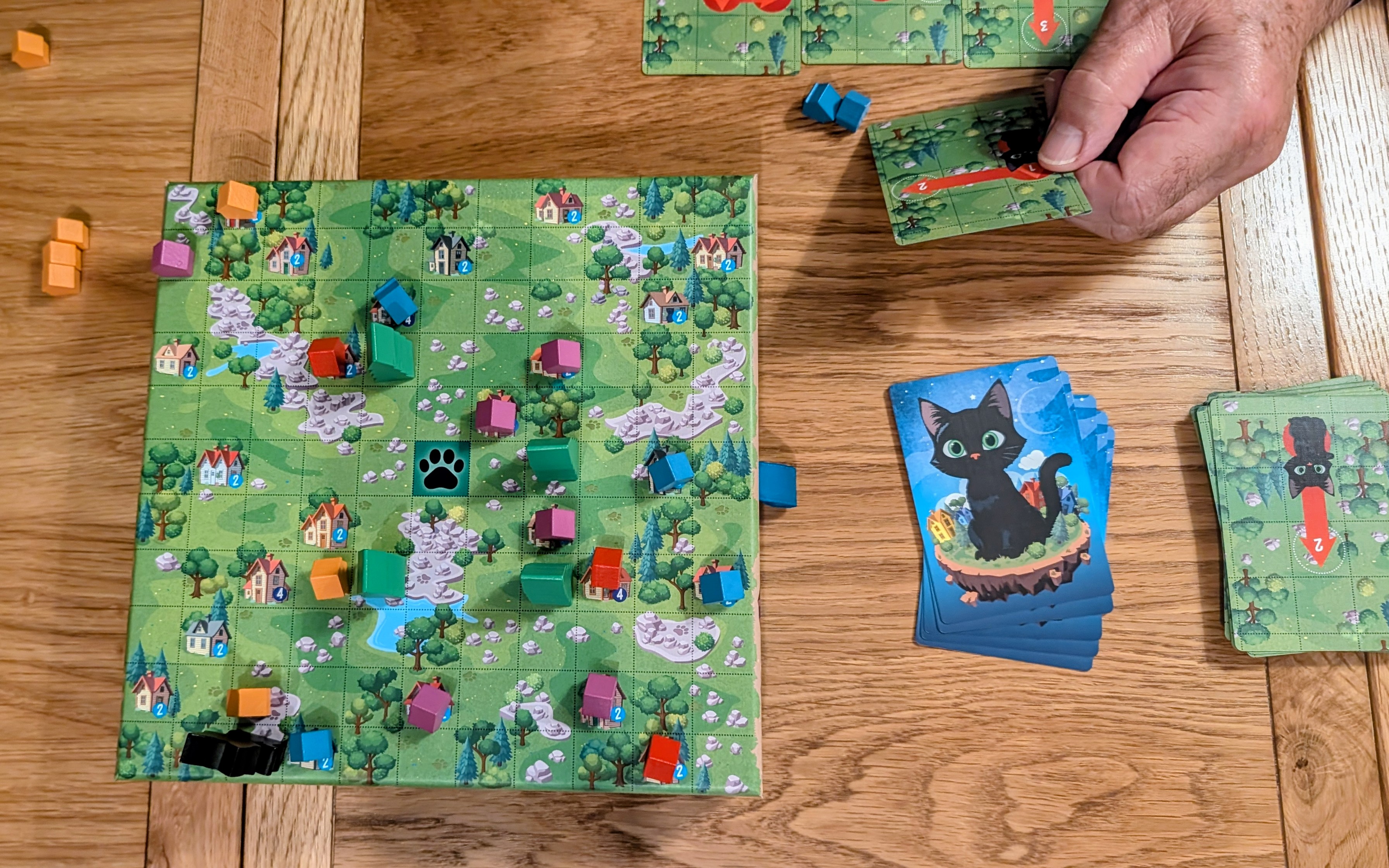
At the start of the game, a single cat is placed in the centre of the board. Players then take turns placing their allocated houses (6-10, depending on the player count) onto the numbered squares. Once all houses are down, each player also gets to place one or two trees, which act as blockers on the board. With everything set, each player draws two movement cards from the deck and the game begins.
The flow of play is nice and straightforward. On each turn, a player draws a card, then plays up to four movement cards – or none at all if they prefer. Each card shows a direction and a number of spaces, and can be used to move one cat. When a cat enters a square containing a house, it pushes that house forward, and the goal is to shove your opponents’ houses off the edge of the board. Finally, at the end of each turn, players discard down to a maximum hand size of four cards if needed.
Once the movement deck is exhausted, a second cat token is placed in the central square and the discard pile is shuffled to form a new deck. This new feline troublemaker can then be moved as normal, ramping up the chaos and making it much harder to hide from roaming cats. The same process repeats each time the deck runs out, up to a maximum of four cats – by which point the game is almost certainly over, with only one player still clinging to houses on the board.
It’s a simple, effective game with a light strategic touch that makes it an easy sell for family game nights. A few fun wrinkles come in the form of Special Cards, which are shuffled into the movement deck and work as follows:
- Teleport — move any cat to an empty space
- Cat Nip — send any cat back to the central space
- House Swap — swap the positions of any two houses on the board
These add some excellent tactical possibilities (especially Teleport, which is almost always a guaranteed house removal), but they’re deliberately limited to keep things fair and prevent any one player from running away with the game.
IS IT ANY GOOD?
Players looking for an in‑depth tactical slog will certainly go home disappointed, but Cat Earth is a neat idea delivered with plenty of eye‑catching visual flair.
Gameplay‑wise, the Special Cards are fun, though the game as a whole is perhaps a little light on variety. I’m not convinced there’s huge replay value here, and many of the big swings come down to blind luck of the draw – never the strongest mechanic.
One minor criticism from our table was that the board feels a touch too small to move pieces around comfortably. There’s definitely an argument for a smaller footprint (and the friendlier price point that comes with it), but we lost count of the number of times a cat movement accidentally nudged a tree or toppled a house.
Overall, though, this is a fun party‑style game that players of all ages can pick up without wrestling with too many rules. With a charming concept and an appealing aesthetic, it’s well worth adding to your casual game‑night rotation.
The writer of this piece was: Craig Neilson-Adams (aka Ceej)
Article Archive: Ceej Says
You can follow Ceej on Twitter


Leave a Reply