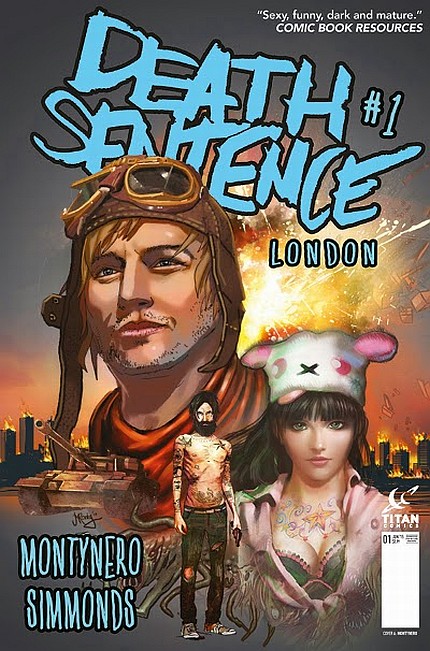
It’s safe to say that we’ve been massive fans of Titan Comics’ Death Sentence since the first issue of the first series. In my review of the first collected volume, I said that writer Monty Nero and artist Mike Dowling had “created something truly special here, something perfectly encapsulated in itself that manages to give a grim look at an exaggerated version of society as well as clear point that drives home the idea of always creating and always expressing.”
The latest series, Death Sentence: London, sees Martin Simmonds taking over from Dowling on art duties, but features exactly the same brand of strong, society-aware writing that has typified Nero’s style.
We were able to sit down and have a chat with Monty about some of the themes behind the series.
Big Comic Page: With regards to the main subject of the latest issue being the London riots, was that something you had in mind to include in this series from the beginning?
Monty Nero: Yes. Mike was drawing the rioting in volume 1 as the London Riots were unfolding outside his window. He was living above a shop in Hackney, and a lot of similar properties were firebombed, so it was scary. I was very worried about him and rang up a few times to offer whatever support I could.
BCP: What is it about the riots in particular that made you feel compelled to include them in the series?
MN: It reminded me how easily society can break down and the number of people I grew up with who felt completely disenfranchised by the system – like they had nothing to lose. It’s a burning global issue. All the other riots across the world, the Arab Spring, Ferguson, Ukraine brought home this conflict between the individual and the state, the militarization of the police, police brutality, oppression of minorities, social media. So exploring that mix is core to everything.
BCP: There is a definite overall tone to the issue which is a bleak outlook and very “street level”. There was a lot of the riots not covered by the media. Do you think that it is something that *should* be made more prevalent by “those that can”?
MN: Definitely.
BCP: Throughout the series, you’ve had a very clear voice and haven’t shied away from showing exactly how you feel about the current government and the way everything has been handled. How were Titan as a publisher throughout this?
MN: They’ve always published exactly what I send them, they’re great to work with. I’d recommend them to anyone.
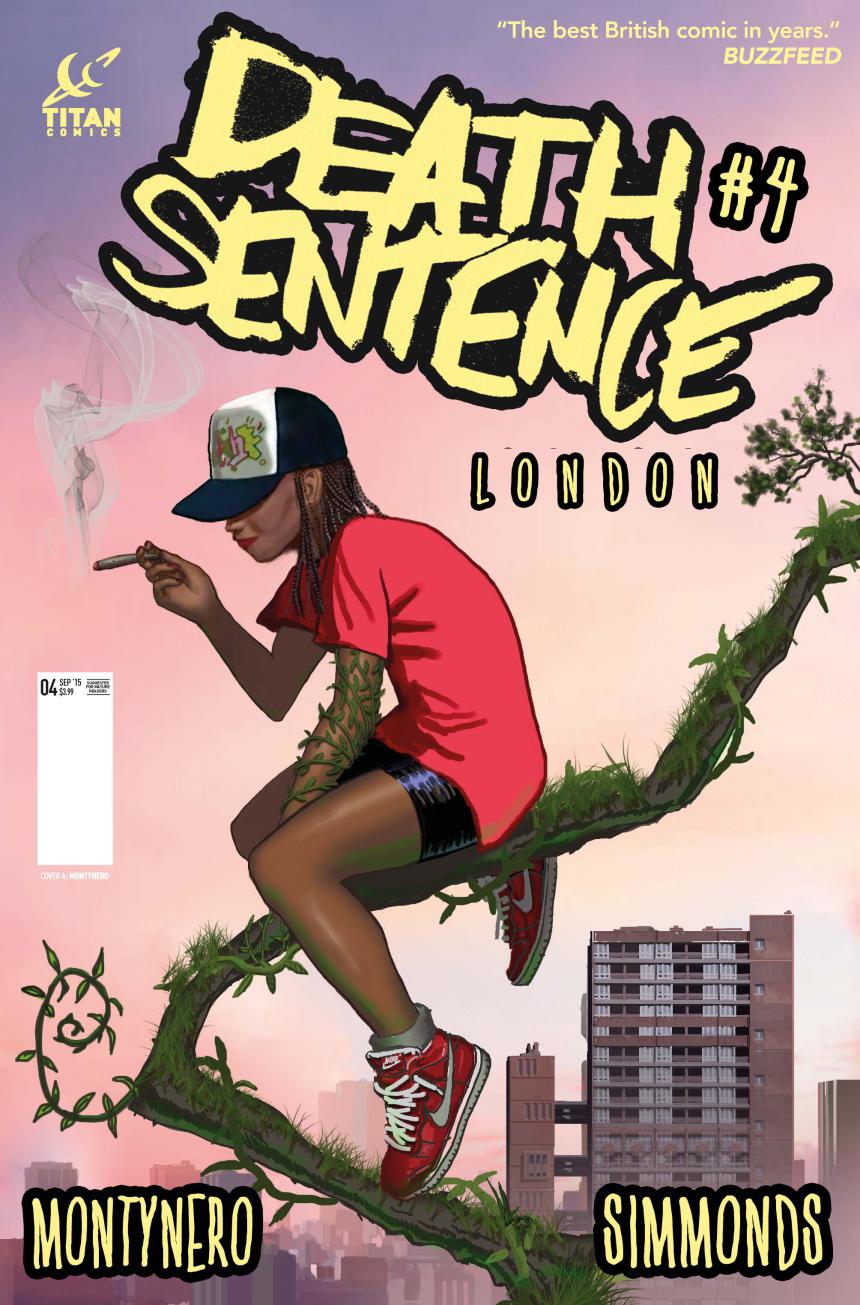
BCP: With regards to your “voice”, do you find it difficult to play devil’s advocate when creating a voice for the villains for the story?
MN: Not at all. I can always see both sides to an issue. I can always see round a person, to understand why they’re doing what they’re doing, often with good intentions. There are no cartoon 2d villains in Death Sentence. More that everyone’s priorities and values bring them into stark conflict.
BCP: There are definite splashes of colour and a brightness to the book which serves as a stark difference from the bleak outlook of the main story. Was this intentional?
MN: Yeah, I’m always delighted by how funny people find Death Sentence. The key to it was finding away to discuss these dark issues with humour and energy, so it’s an exciting read. A point is often better made with satire.
BCP: We’re seeing a lot more of the support cast this time round. Can you tell us much about the new American cast?
MN: Jeb Mulgrew is an undercover FBI agent who’s frustrated by his life. Balancing the needs of his wife and child with his job is proving impossible. Then he gets this chance of a desk position if he completes a mission to steal a potential G-plus cure from an British lab. And what he discovers there shakes his belief system, and goes to the heart of the comic’s premise.
We’ve got new characters in Britain and the USA, as the Gplus virus spreads. It fleshes out the world for future stories.
BCP: Do you feel that the use of social media and camera phones has made it easier for governments to be held accountable, or is it creating a generation where big brother is actually watching more than ever?
MN: Both.
BCP: And finally, how much research did you do for your “hood speak”? Much of it is dead on, but for a few things I can’t help but hear my dad’s voice in my head!–
MN: A bit, because slang is always changing, but it’s not ‘hood speak’ as you call it. It’s MLE – Multicultural London English, and streetwise people speak it all over London and the south East of England. I heard it all around me growing up and it’s largely a mix of English, Caribbean, south asian, african america, and cockney slang. When you’re a kid you want to fit in or look hard, often just to protect yourself, so middle class kids from the suburbs will speak it with their friends when they’re out. The point of slang like that when you’re in a gang is it’s designed to be exclusive, it’s a private language people who aren’t part of your group can’t understand. You modify your vocabulary slightly depending on who’s around. The mistake people make, because of the stereotypes on TV, is they think characters like that can’t say ‘I’m just goin’ to the shops, Mom’ or stuff like that. My policy is always just to write people as they are, from whatever walk of life, while making sure you can always get the gist from the context. And Roots has got a massive character arc ahead of her, so her language will evolve as the G-plus virus changes her profoundly.
BCP: Thanks again for your time, Monty.
Death Sentence: London #5 goes on sale October 14th from Titan Comics, and you can check out a preview of Martin Simmonds’ interior artwork below.
[CLICK TO ENLARGE]


 The writer of this piece was: Chris Bennett
Article: And Now For Something Completely Different
You can also find Chris on Twitter.
 BIG COMIC PAGE
Leave a Reply