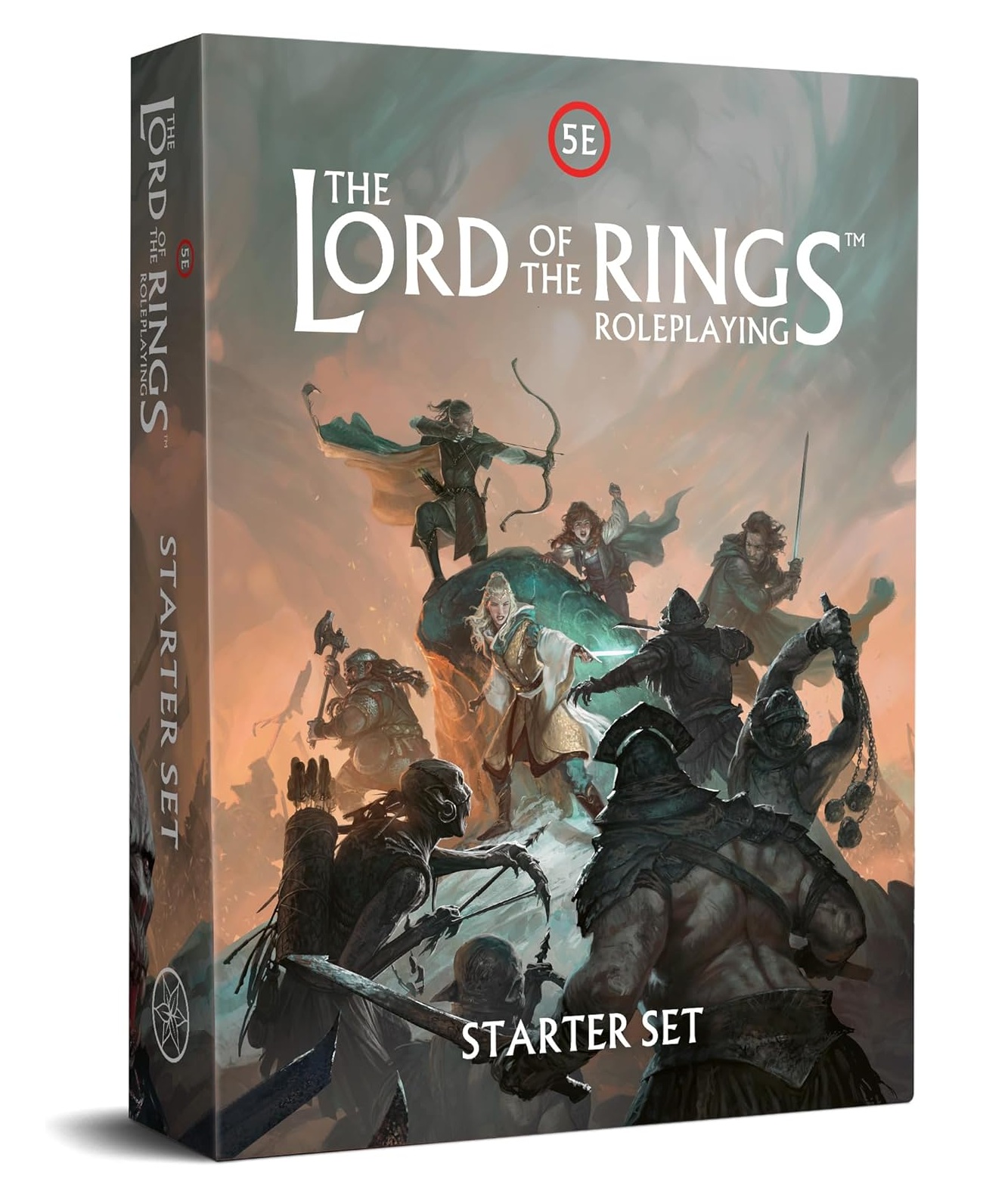
Perfectly pitched for people who are getting a little tired of Dungeons & Dragons and are looking for a new world to play in, but who don’t have the time or energy to learn an entirely new rules system, Free League’s Lord of the Rings RPG takes the familiar core 5e mechanics of “the world’s greatest roleplaying game” and adds a few unique wrinkles. The result is a final product that would make Tolkien himself proud (well… probably).
First Impressions: What’s in the Box?
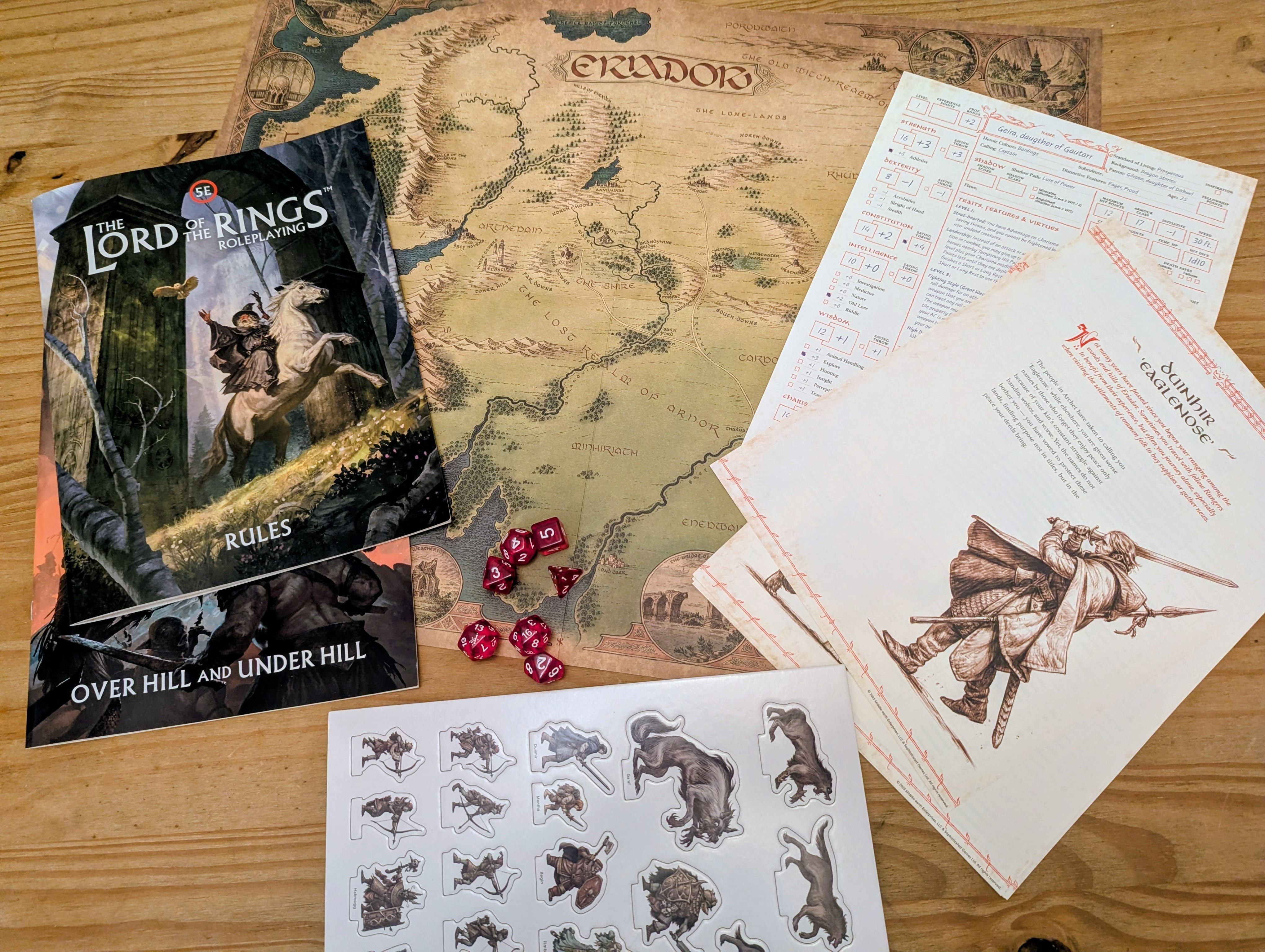
As with all of Free League’s products, the presentation is top-notch, and while perhaps not quite as jam-packed as their recently-released Aliens RPG Starter Set, there’s still some pretty decent bang for your buck here. The box contains:
- A full set of transparent polyhedral dice, including two d20s engraved with the Rune of Gandalf and the Eye of Sauron.
- Condensed 5e rules for action resolution, combat, councils and journeys.
- The complete adventure “Over Hill and Under Hill”, bringing the heroes deep into the wild lands of northern Eriador to face a dark threat.
- A large full-colour map of Eriador, with a combat diagram on the back.
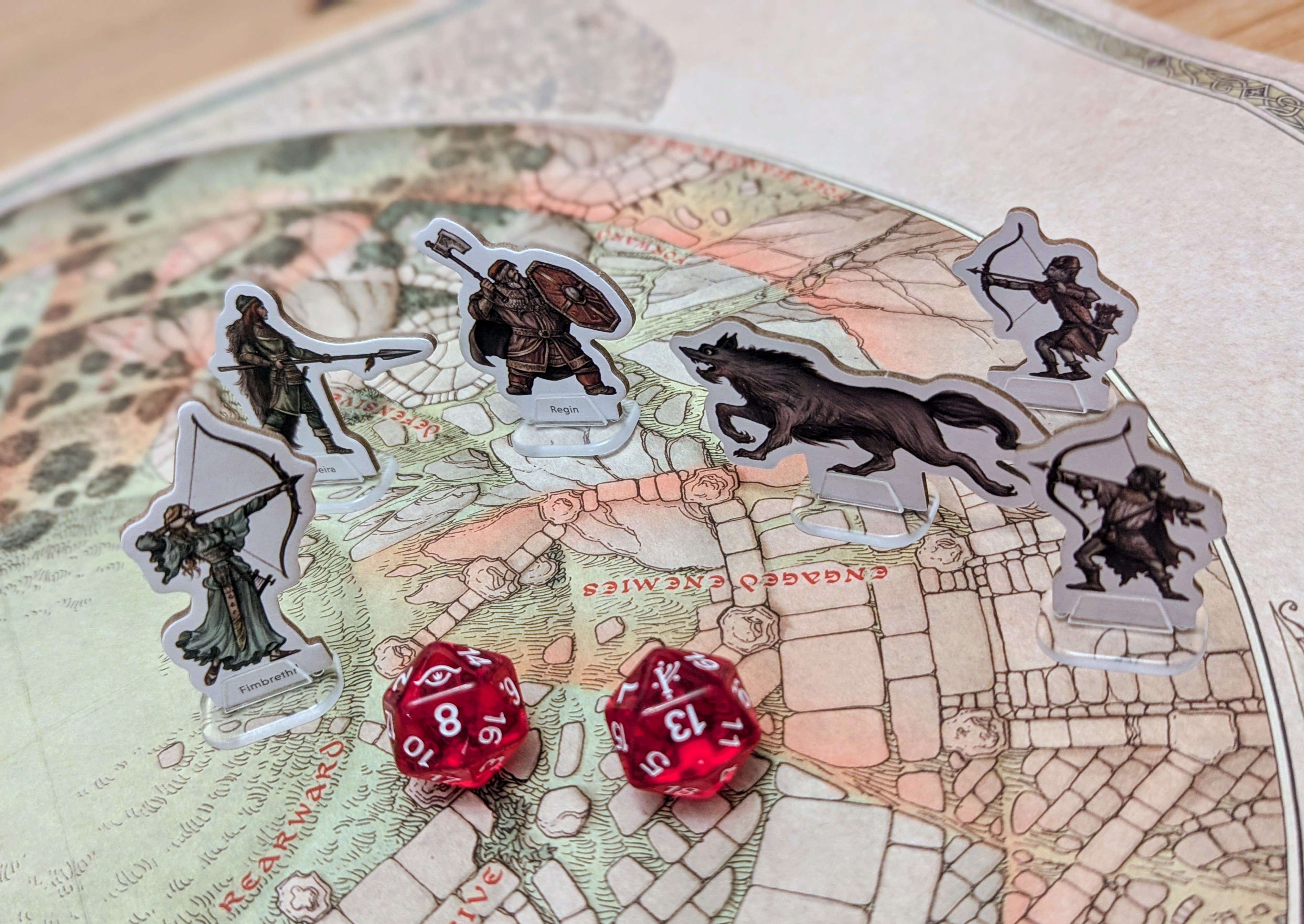
- Beautifully illustrated cardboard stand-up figures for Player-heroes and Adversaries.
- Five pre-generated and illustrated Player-heroes.
The bulk of the rules here are cribbed directly from the well-established Dungeons & Dragons 5e system, albeit with some slight changes to basic terminology (the DM becomes the “Loremaster”, parties become “Companies”, etc.), which makes this an incredibly accessible way to take your tabletop adventures to Middle Earth. While Free League’s other Lord of the Rings RPG, The One Ring, creates its own rulset that feels a little more tailor-made for Tolkien’s world (and is, if we’re being completely honest, a slightly better system as a result), this is still an impressively reshaped version of the existing 5e rules that offers just enough unique tweaks and additions to keep things feeling fresh while still remaining comfortably familiar.
To better suit the world of LotR, there are a few new rules that Free League have thrown into the mix, with mixed results:
“Then Darkness took me, and I strayed out of thought and time”
Firstly, there’s the Shadow system, which represents the darker side of Middle Earth. Players accumulate Shadow Points in a variety of different ways, some external (witnessing distressing events, falling foul of dark sorcery) and some self-inflicted (committing acts of greed or evil). Some of these gains can be resisted with a traditional saving throw and some can’t, but as players accumulate points they risk becoming “miserable” and “anguished”, both of which come with negative modifiers. Pretty cool, right? But it gets better…
In order to remove Shadow Points, players have to “play out a bout of madness”, which is exactly what it sounds like. Per the rulebook, the player must “describe how their hero loses control for a short period of time and does something they will later regret”. Think Boromir trying to take the ring from Frodo at Amon Hem. This takes them one step further along their own individual ‘Shadow Path’, picking up a Flaw as they go. Frustratingly thought, there’s absolutely no information in the Starter Set about the specifics of the Shadow Paths of the premade players or their associated flaws, other than their admittedly quite evocative names (“Dragon Sickness”, “Lure of Secrets”, etc.) Ultimately, once a player has become “anguished” five times, their character is taken out of play entirely as they succumb once and for all to the Shadow.
It cannot be stated how much I love this mechanic, even if the Starter Set rules are more than a little lacking when it comes to actually explaining them. One of the key themes of Lord of the Rings has always been battling against the evil within alongside external evil, and this does a really great job of bringing that to the table, adding some stakes for those who want to play a little fast-and-loose with the morality of the setting while lending the more horrific aspects of Middle Earth even greater weight.
“You have been summoned here to answer the threat of Mordor”
The rules for Councils add an intriguing structure to the “talky” bits of the session. Rather than the straight-up roleplay which happens in regular conversations, when the players are looking to discuss or negotiate something of particular significance, the ‘Council’ rules come into effect. Players agree what they want to get out of the exchange, and the DM sets a required number of successes based on the complexity. Then we get the ‘Introduction Stage’, where a designated spokesperson from the Company makes a DC 15 Charisma check which, depending on how it goes, can either allow them to reroll two checks during the Council, or give them disadvatage on all checks during the Interaction. First impressions count, right?
We then get the ‘Interaction Stage’, which is your usual RP exchange where players make ability checks (Deception, Performance, Insight, Persuasion, etc.) based on what they’re trying to achieve. And finally, once the council is completed, there are a range of outcomes, from the players getting what they want to the people they’re meeting now seeing them as a threat.
At the end of the day, it’s not too different from the way most D&D exchanges play out, but I do like the added structure for what is, after all, a fundamental part of the Lord of the Rings world.
“If I take one more step, it’ll be the farthest away from home I’ve ever been”
And finally, we have Journey rules, which cover all the parts of the adventure where you travel from one place to another. And, if you’re familiar in any way with the source material, you’ll know that there’s a lot of walking in those books. This gets a little convoluted at times, and is honestly probably the weakest of the new rules. Each player is assigned a “role” (Guide, Scout, Look-Out or Hunter, doubling up if there’s less than 4 players), a path is chosen (using the map provided), and a series of Wisdom checks are made to see how the journey goes.
Events will take place at various points of the journey (determined by rolls made by the Guide), and each event ‘targets’ one of the other three roles, who need to make a roll to overcome it, depending on what it is. There’s also fatigue, exhaustion, and a few other mechanics that, if I’m being 100% honest, bog down what should be a rich, narratively-enjoyable section of the game. Can’t win ’em all, I guess.
“A sword-day, a red day, ere the sun rises!”
Thematically, Middle‑earth shares a lot of DNA with the Forgotten Realms, but I really appreciate how much the magic has been toned down here. It feels more special, more deliberate, and gives the whole experience a grounded authenticity that fits the setting beautifully. There’s no fun having an entire party of Gandalfs, now is there? (Well, actually…)
Combat remains broadly familiar, albeit with the introduction of a range system where characters fight at different distances, from ‘Engaged’ (5 ft) to ‘Extreme’ (up to 300 ft), each with its own bonuses and penalties. Grid‑based movement has been removed entirely, which simplifies things significantly – for better or worse. You do lose some of the tactical maneuvering, flanking, and cover that made D&D so enticing, but there’s a smooth, elegant flow to the new system that works for me. Your individiual mileage may vary.
Players and enemies choose ‘Stances’ (Forward, Open, Defensive or Rearward) which determine how they act during the combat, and are placed in the relevant part of the battle map. The DM then assigns enemies to players based on their ranges, before combat is resolved in a fairly familiar “Attack Roll, Armour Class, Damage, Critical Hit, etc.” 5e fashion.
As I say, it’s a far more streamnlined (and, dare I say, simplistic) version of the combat that a lot of D&D diehards will be used to, and could be something of a dealbreaker as a result. It feels less tactical, and perhaps a little more random, but at least it runs smoothly and quickly, and should hopefully be easy for new players that don’t have the D&D fundamentals hardcoded into them to pick up.
“I think I’m quite ready for another adventure”
As with all Starter Sets, this box comes with an introductory adventure to help the players (and Loremaster) experience the world, play a few sessions with the rules, and ultimately decide whether they want to keep playing with this new system. The adventure here is entitled “Over Hill and Under Hill”, and is designed to last around 4-5 hours, with three distinct parts and an epilogue. I won’t go too deeply into the content for risk of spoiling the impact, but it suffice to say it begins in a tavern (in this case, quite a familiar one in Bree), and sees the players working for their sponsor to help deal with a long-forgotten threat in the North Downs.
In terms of layout, the booklet is incredibily easy to follow, even for a fledgling DM (sorry… Loremaster), and succinclty breaks down all the key moments along the way. The description text is wonderfully flavourful and coded very much to the world of Middle Earth, the combat sections are exciting without ever feeling overwhelming, and there’s even a cheeky cameo from a familiar face thrown in midway through that should elicit cheers of excitement at all but the most jaded tables.
For this adventure players choose from one of the six premade characters, each with their own interesting backstory, although some are significantly more interesting than others (being a baby who survived Smaug’s razing of Lake Town is way cooler than just being a random Dwarf whose father was killed by a poinsed arrow), and there’s enough variety here to keep the game exciting. All in all, as far as introductory adventures go, this one is guaranteed to satisfy players on both side of the LM screen.
“All we have to decide is what to do with the time that is given us.”
Ultimately, Free League’s Lord of the Rings RPG starter set is perfectly designed to fill a specific niche – namely, people who know the D&D rules and are keen to expand their adventures into the world of Middle Earth. There are some changes that work (the Shadow System, rules for Councils), and some that frankly don’t (the Journey Rules for one), but the overall presentation and game design is likely to appeal to a lot of players out there. For complete newbies there’s no doubt that Free League’s The One Ring has a far superior system, so if you’re starting from scratch with no prior TTRPG knowledge I’d definitely recommend you start there, but if you’re already D&D savvy and fancy a little dabble into Tolkien’s stunning world, you could certainly do a lot worse than picking this one up.
Rating: 4/5.
The writer of this piece was: Craig Neilson-Adams (aka Ceej)
Article Archive: Ceej Says
You can follow Ceej on Twitter


Leave a Reply