 DOOMLINGS OVERVIEW
- 2-6 Players
- Recommended age: 8+
- 20-45 minutes
- RRP: £18.95 (Order HERE)
Last November, we took a look at the 2nd edition of Doomlings, a lightweight, strategic, humour‑filled card game about guiding a quirky little species through the ages… right up until the moment the world ends. We praised the game, calling it a “fun, snappy affair, with the sheer variety of cards and abilities offering up a wide option of tactics and approaches”, thought we did also note a few confusing moments when trying to determine how certain cards interacted, etc.
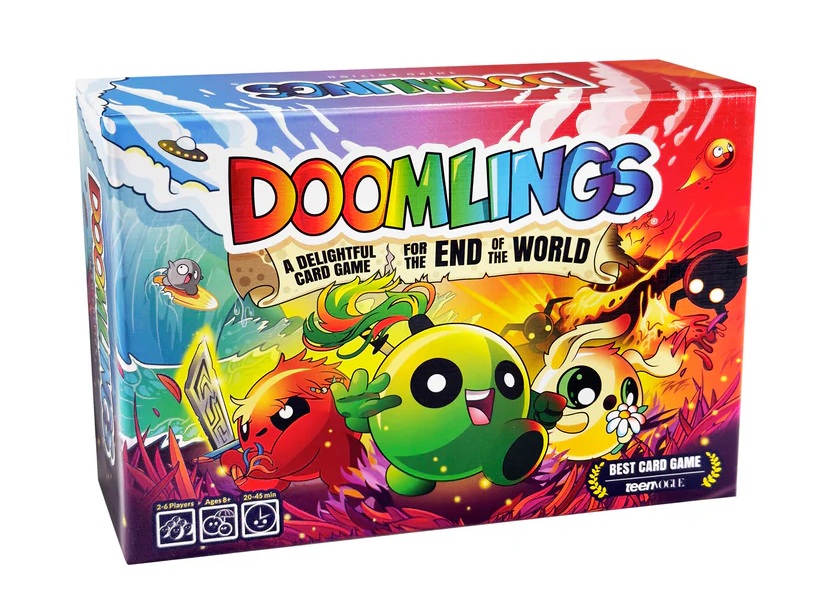
Enter Doomlings: Third Edition, an updated version featuring 160 redesigned cards with all‑new art, refined mechanics, streamlined rules, and gameplay improvements that add more strategic agency while preserving the chaotic spirit of the original. In the creators’ own words, this is “the version of Doomlings we always dreamed the base game could become”, which sounds pretty great to us.
Let’s dive in!
WHAT’S IN THE BOX?
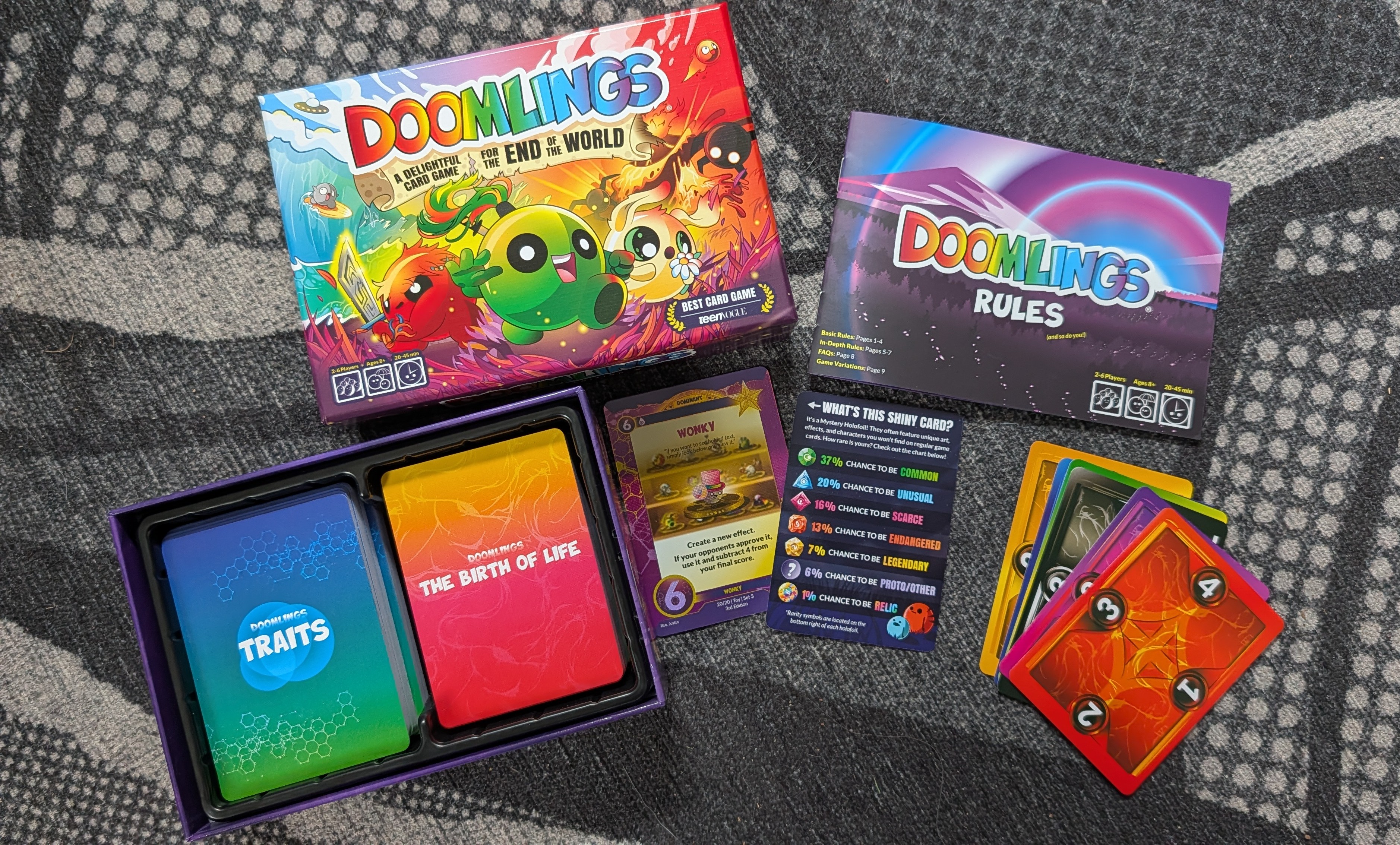
First and foremost, it’s worth pointing out that the box itself is significantly scaled down from the second edition. And while I appreciate there was a hefty amount of ‘dead’ space in the previous version’s box to allow room to store additional expansions etc., as a standalone product this is way more shelf-friendly – particularly if you find yourself struggling with space for new games (which, let’s be honest, we all are, right?)
In terms of contents, it’s pretty much exactly the same as the 2nd edition (see below):
- Doomlings Base Game – 160 cards needed to play Doomlings.
- Doomlings Classic Box – The new Doomlings Remastered classic game box featuring colorful new artwork.
- Doomlings Rule Book – New & improved!
- One Mystery Holofoil Card!
The artwork and cardstock are still of a very high quality, and I really love some of the quicky Doomling designs. Bright, colourful and eye-catching at the table.
HOW DO YOU PLAY?
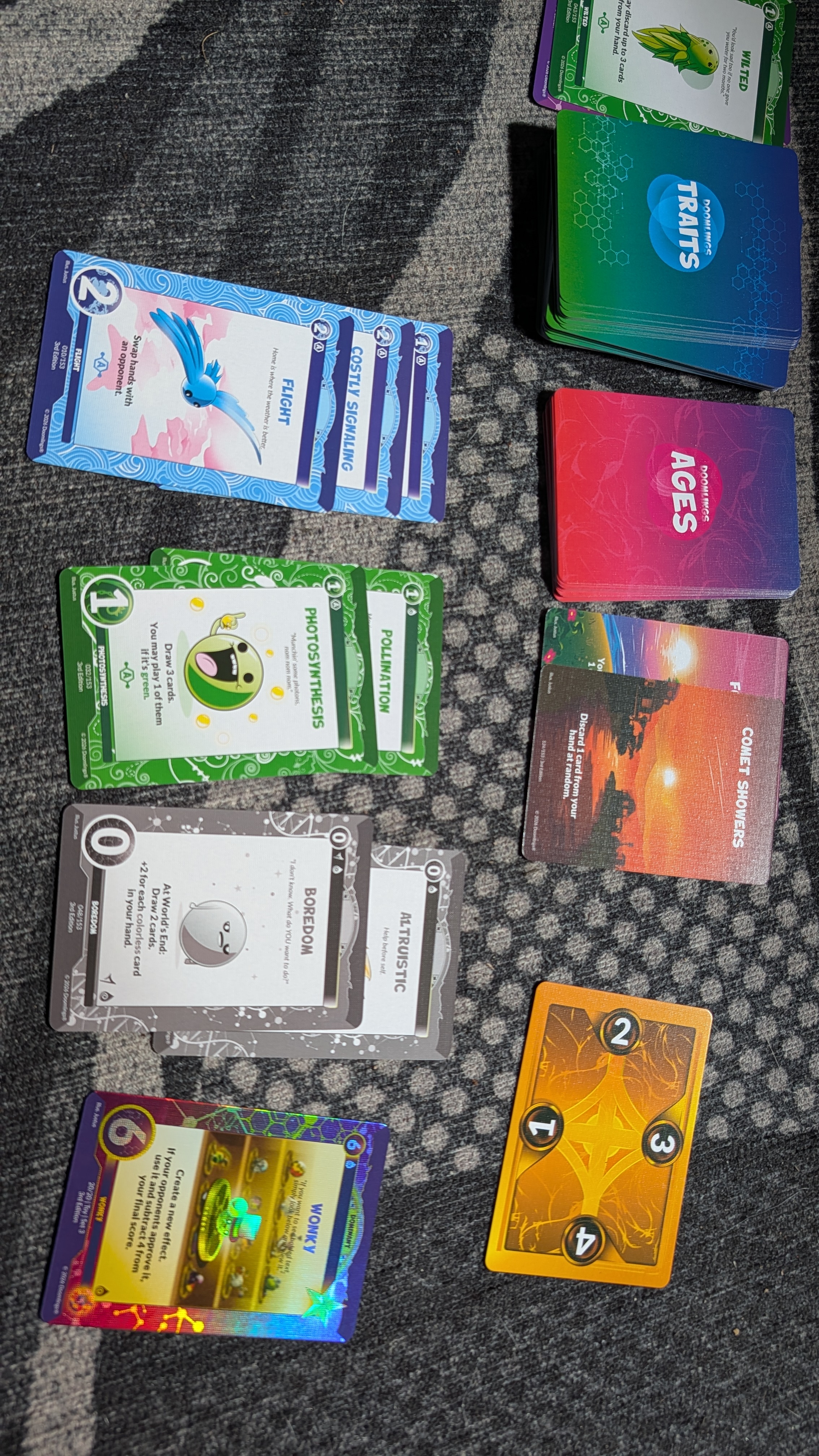
As before, the game consists of four different card types:
- Trait Cards – Represent characteristics of your species and are the main source of points.
- Age Cards – Introduce new rules or effects each round.
- Catastrophe Cards – A subset of Age Cards that disrupt gameplay and signal the approaching end.
- Gene Pool Cards – Indicate your hand size limit and help manage card flow.
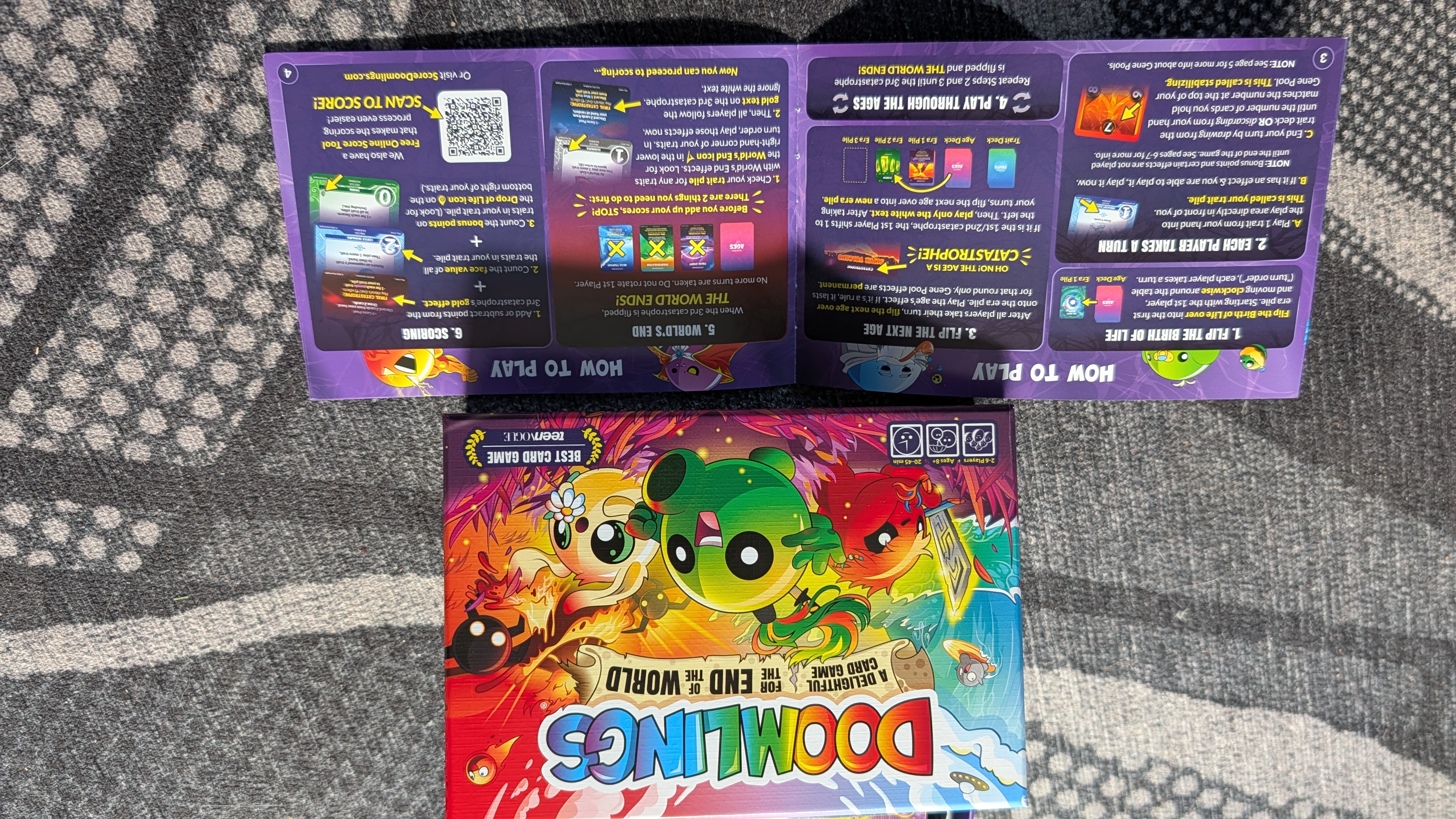
Gameplay is fairly straightforward: each player is initially dealt 5 Trait Cards. At the beginning of every round (or “Age”), a player flips over an Age Card, which sets the rules for that round (e.g. “you cannot play blue traits”, “you can discard 1 card from your hand to draw 2 cards”, etc.) Then, each player takes a turn by playing a Trait Card from their hand to the table, followed by drawing up or discarding down to match the number of cards allowed by their Gene Pool (this process is called “Stabilising.”) The next round begins with a new Age Card being flipped, and the cycle continues.
Adding urgency to the game are the Catastrophe Cards, which are shuffled into the Ages Deck. Each one introduces different effects, frequently negative, and when the third Catastrophe is drawn, the game ends. The Ages Deck contains 9 Age Cards and 3 Catastrophe Cards, meaning players have a maximum of 12 rounds to accumulate the most points possible before the world ends!
And that’s the basic core of the game.
Of course, there’s a bit more depth to it. Trait Cards interact in various ways – providing various bonuses for colour pairs, imposing penalties on opponents, etc. However, much of the strategy seems to rely on intuition rather than encyclopedic knowledge of the cards. Heck, as the rules themselves suggest: “Play something cute, try some things, and trust that the cards will help you find your way.”
This approach makes the gameplay flow smoothly throughout, and while there are certainly strategies and tactics that can be picked up through repeated playthroughs (getting as many different colour types, ideally in pairs, onto the table is generally considered a solid idea, for example), there are enough chaotic elements to ensure that things can shift fairly rapidly from turn to turn, meaning that Doomlings is great for those who like their strategy on the lighter side.
WHAT’S NEW IN THE THIRD EDITION?
First off, the rules are significantly easier to navigate this time around, not just because of the cleaner layout but because they’re now printed in an intuitive booklet rather than an unwieldy fold‑out “map”. I’m still not sure whose idea that was in the first place, but I’m very glad it’s been fixed.
Perhaps the biggest overall improvement is the updated icon system on Trait cards, which makes it much clearer when effects occur and how they’re scored at the end of the game. Two new icons have been added: Persistent (the card’s effect is triggered by a future event and may recur) and Requirement (a condition must be met before the Trait can be played). Both concepts existed in the text previously, but spelling them out with simple, easy‑to‑identify icons goes a long way toward streamlining gameplay.
Beyond that, most of the changes are card‑specific and focused on balance, which again speaks to the creators’ willingness to take feedback on board. Some wording has been tightened, and several effects have been tweaked to increase or decrease their impact. It’s hard to spot these adjustments in detail at the table unless you have an encyclopaedic memory of the previous versions, but the game now plays very smoothly and feels noticeably more balanced, with no obvious “killer” or “dud” cards.
It’s also worth noting that the price point is significantly lower — roughly £19 compared to £26 for the second edition — which is always a welcome change.
FINAL THOUGHTS
While the basic structure of the game remains largely the same, Doomlings: Third Edition feels like a love letter to fan feedback – clear proof that the creators are listening and genuinely willing to make whatever changes are needed to improve the player experience.
That said, our main niggle from last time does still linger: it’s incredibly hard to know how well you’re actually doing while the game is in progress. Are you narrowly ahead? Getting absolutely flattened? Unless you’ve got a calculator for a brain, it’s tough to tell, which can feel a little isolating despite the otherwise lively, rapid‑fire nature of the game. The online score calculator is still great once everything’s wrapped up, but it doesn’t help much while Traits are flying onto the table.
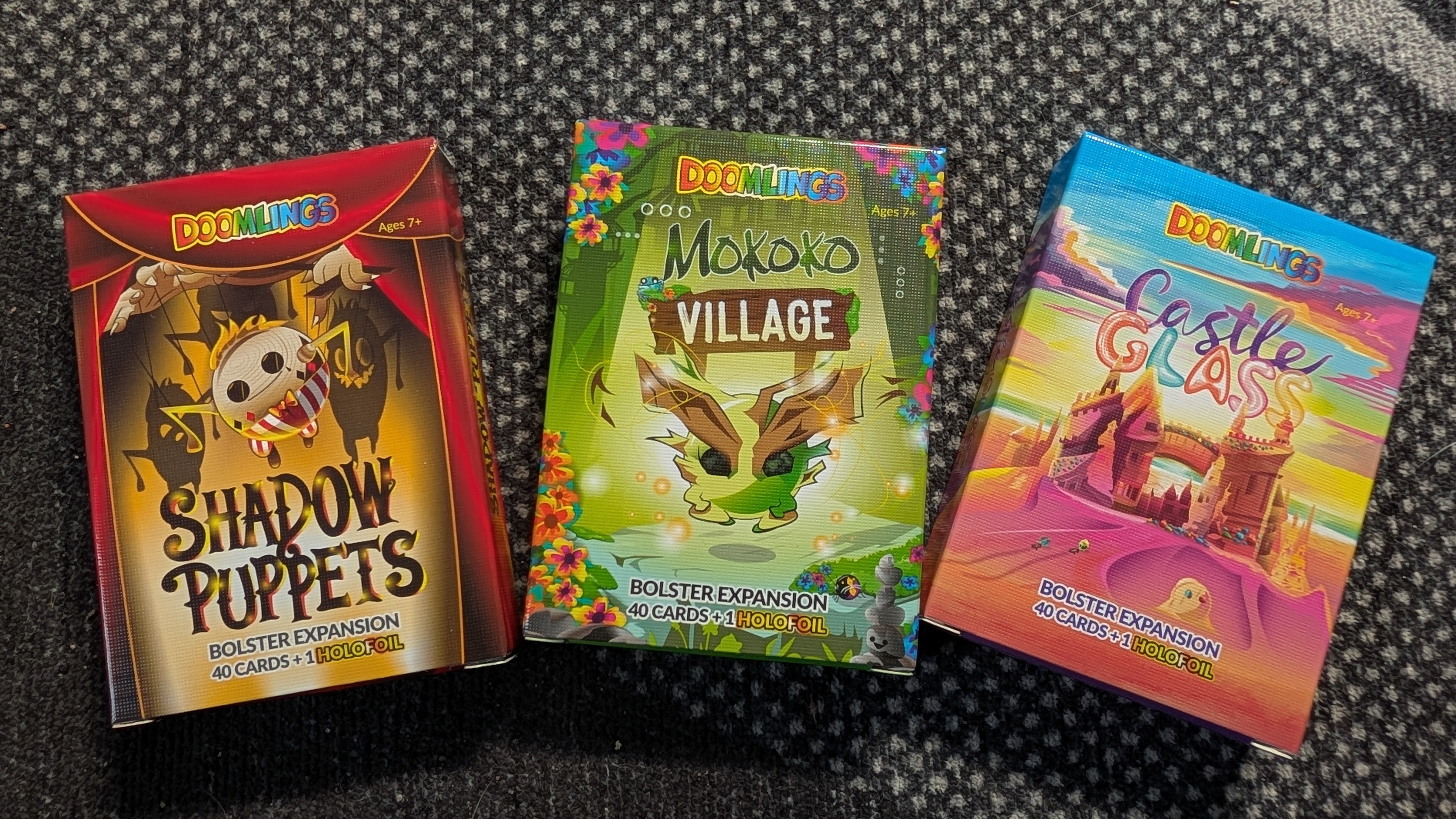
Even so, this remains a vibrant, eye‑catching, family‑friendly game that’s likely to be a hit at most game nights. The colourful cards and straightforward rules make it instantly appealing, and with a whole suite of bolster expansions available (keep an eye out – we’ll be reviewing some of the ones below in the coming weeks), there’s plenty of mileage here if it becomes a table favourite. It’s well worth a look, and once again, I can’t overstate how refreshing it is to see creators so open to improvement and feedback. More companies should take note.
Domlings Third Edition is available from the official Doomlings Online Store
The writer of this piece was: Craig Neilson-Adams (aka Ceej)
Article Archive: Ceej Says
You can follow Ceej on Twitter


Leave a Reply